Unique Homes MA
Tudor Revival Homes in Massachusetts
Tudor Revival (1890-1945) brought English late-medieval and early-Renaissance forms to American suburbs — half-timbered gables, casement windows, Cotswold cottages. Massachusetts's western suburbs have substantial inventories.
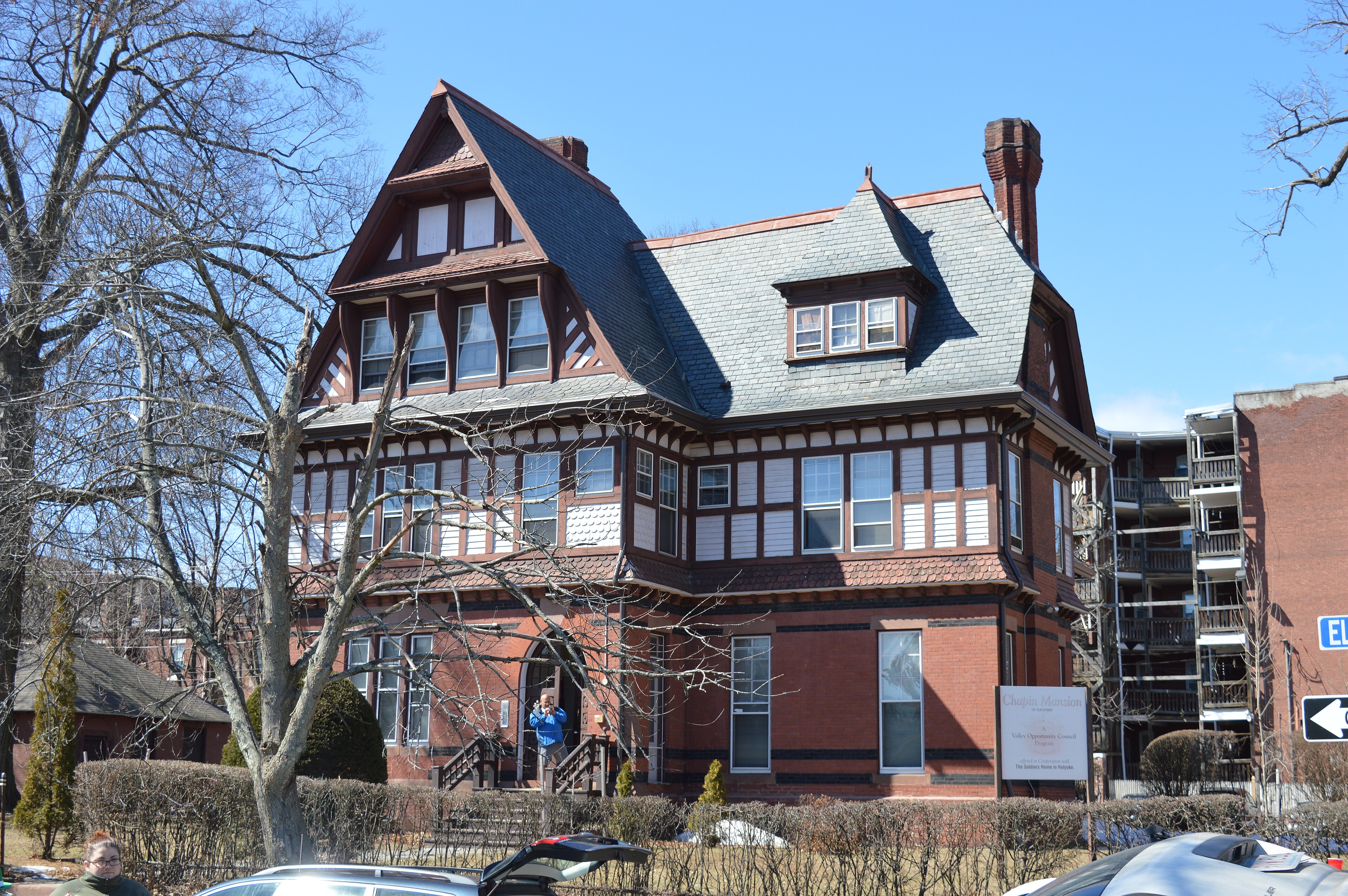
What is a Tudor Revival?
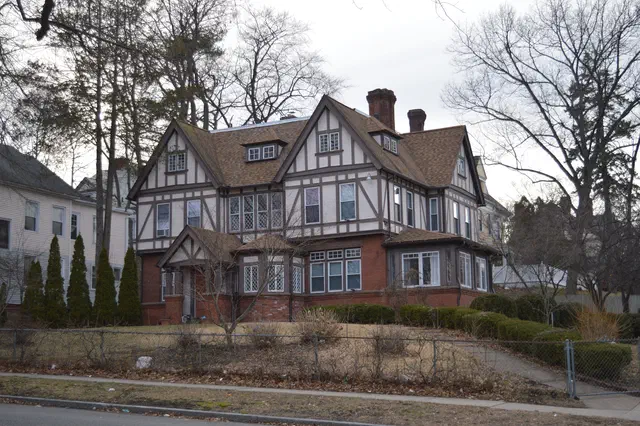
A Tudor Revival is the storybook house. Steep front gables, dark wood beams crossing pale stucco, a tall chimney out front, narrow windows with little leaded panes: it looks like it stepped out of an English fairy tale and landed in a Massachusetts suburb. The look comes from old English cottages and manor houses, dressed up for American families who wanted romance. These houses were the height of fashion in the 1920s and early 1930s, and Massachusetts has a lot of them in the leafy western suburbs that grew up around the commuter trains. The grandest were architect-built; many more were smaller versions for ordinary buyers.
Why it’s special
Almost nothing else looks like a Tudor. While the neighbors built tidy white Colonial homes, the Tudor buyer wanted a little drama. The half-timbering is the giveaway: those dark beams set into stucco in the gable peaks. On the finest houses the woodwork is the real frame showing through; on the everyday ones it is decoration. The other treats are in the details: a front door tucked into a rounded stone arch, a big chimney with patterned brick and tall pots, and walls that mix brick, stone, and stucco.

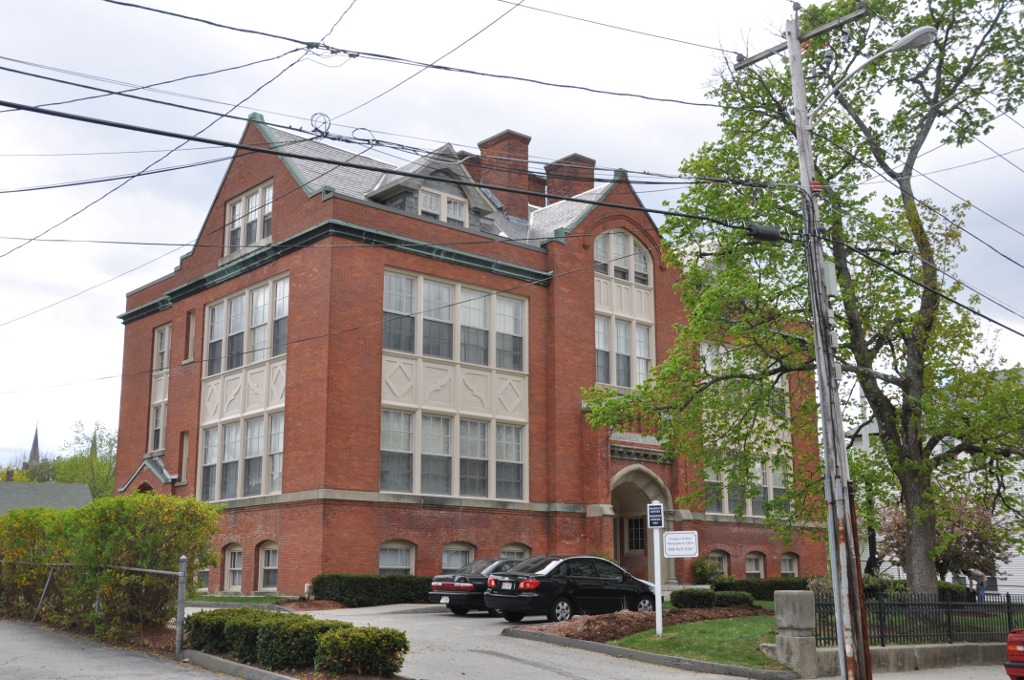
What it’s like to live in one
A Tudor wraps you in cozy, old-world rooms. Dark beams, leaded glass, and a real hearth give the place a warmth no new house copies well. In Massachusetts they cluster in the comfortable western suburbs. Wellesley, Newton, and Belmont have the most of the big architect-built estates, and Brookline’s Pill Hill has earlier, smaller ones. Cottage-sized storybook Tudors turn up across streetcar towns like Arlington and Winchester, and out west in Springfield and Longmeadow. Going in, know that a Tudor asks for care: slate roofs and leaded windows need specialists, and the big chimneys often need work before the fireplaces are usable.
Is it the real thing?
A true Tudor Revival comes from roughly 1890 to 1945, with most Massachusetts examples from the 1920s. The surest tell is the steep front gable with half-timbering and the tall, narrow windows. Wider windows and plain white clapboards point to a Colonial Revival instead. The beam-covered Stick Style is older and rare here, so a half-timbered house in this state is almost always a Tudor. There is also a real gap between an architect-built estate and a small tract Tudor: the estates have slate roofs, hand-cut stone, and genuine timber framing, while the cottages borrow the look with applied trim. MACRIS confirms a house’s date and history.
Last reviewed
Common questions about Tudor Revival homes
How do you identify a Tudor Revival home?
- A steep front-facing gable, often more than one
- Decorative half-timbering (dark wood beams over light stucco) in the gable peaks
- Tall, narrow windows, sometimes with small leaded diamond panes
- A big, prominent chimney, often with patterned brick and tall chimney pots
- An off-center, asymmetrical front
When were Tudor Revival homes built?
Tudor Revival homes were built during 1890–1945.
Where in Massachusetts are Tudor Revival homes found?
- Wellesley, Newton (especially Chestnut Hill, Newton Centre, West Newton), Belmont — high-style 1920s–30s estates
- Brookline (Pill Hill, Fisher Hill, Cottage Farm) — earlier 1900s–10s
- Streetcar suburbs — Arlington, Watertown, Winchester, Melrose, Milton
Who designed notable Tudor Revival homes in Massachusetts?
- Allen, Collens & Willis — Boston firm responsible for major Tudor estates in Wellesley and Belmont
- Hardie Phillips — 1920s Newton and Brookline residential Tudor commissions
- Henry Vaughan (1845–1917) — English-trained architect who brought authentic Tudor detailing to MA ecclesiastical and residential work
- Coolidge, Shepley, Bulfinch & Abbott — Tudor and Tudor-Gothic institutional buildings in Boston and Cambridge
- Andrew Hepburn — Wellesley and Weston estate Tudors of the 1920s
Current listings (44)
For Sale
$2,495,000
14 Homestead
Newton
4 bds | 3.5 ba | 3,105 sqft | Built 1925
MLS ID #73535516, Compass
For Sale
$749,000
73 Florence Ave
Melrose
3 bds | 1.5 ba | 1,726 sqft | Built 1900
MLS ID #73535366, Compass
For Sale
$950,000
272 Eastford Rd
Southbridge
2 bds | 3.5 ba | 2,946 sqft | Built 1942
MLS ID #73535159, Timber Real Estate
For Sale
$487,900
13 Marilyn Drive
Auburn
3 bds | 2.5 ba | 1,381 sqft | Built 1945
MLS ID #73517472, Lamacchia Realty, Inc
For Sale
$399,900
146 Bellevue Ave
Springfield
3 bds | 2 ba | 2,099 sqft | Built 1927
MLS ID #73519630, Coldwell Banker Realty - Western MA
For Sale
$499,900
19 Harwich Road
Longmeadow
5 bds | 2.5 ba | 2,170 sqft | Built 1930
MLS ID #73534879, William Raveis R.E. & Home Services
For Sale
$939,900
234 County St
Attleboro
6 bds | 3.5 ba | 4,249 sqft | Built 1910
MLS ID #73534889, Village Realty HM, LLC
For Sale
$1,199,999
9 MAYFIELD RD
Belmont
3 bds | 1.5 ba | 1,736 sqft | Built 1934
MLS ID #73534169, Coldwell Banker Realty - Lynnfield
For Sale
$2,000,000
46 Acacia Ave
Newton
4 bds | 2.5 ba | 2,737 sqft | Built 1938
MLS ID #73484975, Phoenix Real Estate Partners, LLC
For Sale
$8,800,000
84 Garden St
Cambridge
9 bds | 5.5 ba | 5,734 sqft | Built 1922
MLS ID #73428300, Gibson Sotheby's International Realty
For Sale
$599,900
26 W Elm Ter
Brockton
4 bds | 2.5 ba | 2,328 sqft | Built 1925
MLS ID #73533328, RE/MAX Synergy
For Sale
$2,700,000
79 Woodchester Dr
Newton
4 bds | 4.5 ba | 4,340 sqft | Built 1930
MLS ID #73533169, Romo Realty Group
For Sale
$1,699,000
127 Larchmont Road
Melrose
4 bds | 3 ba | 5,020 sqft | Built 1942
MLS ID #73529131, Coldwell Banker Realty - Boston
Under Contract
$699,000
270 Elm St
Walpole
3 bds | 2 ba | 1,583 sqft | Built 1932
MLS ID #73529955, Navigate Real Estate Corp.
For Sale
$2,600,000
4 Madison St
Belmont
4 bds | 3 ba | 3,601 sqft | Built 1931
MLS ID #73529867, Coldwell Banker Realty - Belmont
For Sale
$2,299,000
518 Newton St
Brookline
4 bds | 2 ba | 3,615 sqft | Built 1930
MLS ID #73529380, Winterspring Real Estate, LLC
For Sale
$5,850,000
124 Chestnut Hill Rd
Newton
5 bds | 7.5 ba | 7,359 sqft | Built 1925
MLS ID #73527607, MGS Group Real Estate LTD
For Sale
$2,900,000
82 River Rd
Topsfield
7 bds | 3.5 ba | 5,280 sqft | Built 1909
MLS ID #73527545, LandVest, Inc., Ipswich
Under Contract
$3,985,000
120 Grapevine Rd
Wenham
6 bds | 5 ba | 7,850 sqft | Built 1926
MLS ID #73523975, LandVest, Inc., Manchester -by-the-Sea
For Sale
$2,150,000
16 Lancaster Rd
Newton
4 bds | 2.5 ba | 4,127 sqft | Built 1929
MLS ID #73524958, Compass
For Sale
$2,400,000
72 Beverly Road
Brookline
4 bds | 4.5 ba | 4,067 sqft | Built 1935
MLS ID #73524920, Coldwell Banker Realty - Brookline
For Sale
$1,299,000
11 Venner Road
Arlington
4 bds | 2 ba | 2,758 sqft | Built 1933
MLS ID #73519075, Senne
For Sale
$1,500,000
760 Washington St
Whitman
4 bds | 4 ba | 4,862 sqft | Built 1934
MLS ID #73520219, Escalate Real Estate
For Sale
$1,095,000
1103 Morton St.
Boston
6 bds | 3 ba | 2,574 sqft | Built 1935
MLS ID #73512266, Kava Realty Group, Inc.
For Sale
$499,000
158 Wenonah Rd
Longmeadow
4 bds | 1.5 ba | 1,944 sqft | Built 1928
MLS ID #73512532, Cuoco & Co. Real Estate
For Sale
$1,398,000
291 Russett Rd
Brookline
3 bds | 2 ba | 2,590 sqft | Built 1935
MLS ID #73516707, William Raveis R.E. & Home Services
Under Contract
$2,675,000
47 Yale Street
Winchester
6 bds | 3 ba | 4,540 sqft | Built 1920
MLS ID #73516849, Coldwell Banker Realty - Belmont
For Sale
$799,000
61 Woodlawn Ave
Northampton
4 bds | 2 ba | 1,686 sqft | Built 1937
MLS ID #73511988, Brick & Mortar Northampton
Under Contract
$2,499,000
32 Alberta
Brookline
5 bds | 4.5 ba | 3,873 sqft | Built 1930
MLS ID #73508462, Classic Realty
For Sale
$2,900,000
81 Brackett Rd
Newton
5 bds | 4.5 ba | 6,260 sqft | Built 1941
MLS ID #73505180, William Raveis R.E. & Home Services
For Sale
$6,925,000
98 Carlton St
Brookline
4 bds | 3 ba | 5,019 sqft | Built 1935
MLS ID #73504938, Douglas Elliman Real Estate - The Sarkis Team
For Sale
$998,000
3 Old Brook Dr
Worcester
5 bds | 5 ba | 4,415 sqft | Built 1941
MLS ID #73503428, Lanagan & Co
For Sale
$2,250,000
9-11 Hampden Street
Wellesley
8 bds | 4 ba | 5,559 sqft | Built 1920
MLS ID #73503038, eXp Realty
For Sale
$3,495,000
3 Evergreen Ln
Hingham
6 bds | 4.5 ba | 6,000 sqft | Built 1932
MLS ID #73485019, Compass
For Sale
$4,449,000
4 Dartmouth St
Winchester
5 bds | 5.5 ba | 6,526 sqft | Built 1935
MLS ID #73482952, Gibson Sotheby's International Realty
For Sale
$3,999,000
41 Hayward Rd
Barnstable
4 bds | 4 ba | 2,868 sqft | Built 1925
MLS ID #73493154, Keller Williams Realty
For Sale
$3,995,000
55 Penniman Rd
Brookline
4 bds | 3 ba | 4,320 sqft | Built 1922
MLS ID #73486005, MGS Group Real Estate LTD
For Sale
$16,000,000
63 Goddard Avenue
Brookline
6 bds | 6.5 ba | 9,411 sqft | Built 1915
MLS ID #73480812, Hammond Residential Real Estate
For Sale
$494,000
860 Pleasant St
Worcester
3 bds | 1.5 ba | 1,461 sqft | Built 1930
MLS ID #73491984, Coldwell Banker Realty - Worcester
For Sale
$1,849,000
701 Country Way
Scituate
4 bds | 3 ba | 6,175 sqft | Built 1893
MLS ID #73478301, Compass
Sold
$1,220,050
33 Longfellow Road
Melrose
3 bds | 1.5 ba | 1,556 sqft | Built 1935
MLS ID #73518354, Coldwell Banker Realty - Cambridge
Sold
$2,430,000
26 Bothfeld Rd
Newton
4 bds | 3 ba | 4,368 sqft | Built 1920
MLS ID #73498391, Coldwell Banker Realty - Newton
Sold
$3,100,000
44 Bradford Rd
Wellesley
5 bds | 5.5 ba | 4,785 sqft | Built 1917
MLS ID #73482717, Compass
Sold
$532,000
80 Highland Avenue
Fitchburg
3 bds | 2.5 ba | 3,300 sqft | Built 1931
MLS ID #73446044, Foster-Healey Real Estate