Unique Homes MA
Second Empire Homes in Massachusetts
Second Empire (1855-1890) brought Parisian mansard roofs to American architecture. Boston's South End, Roxbury, and the industrial cities have rich Second Empire inventories.
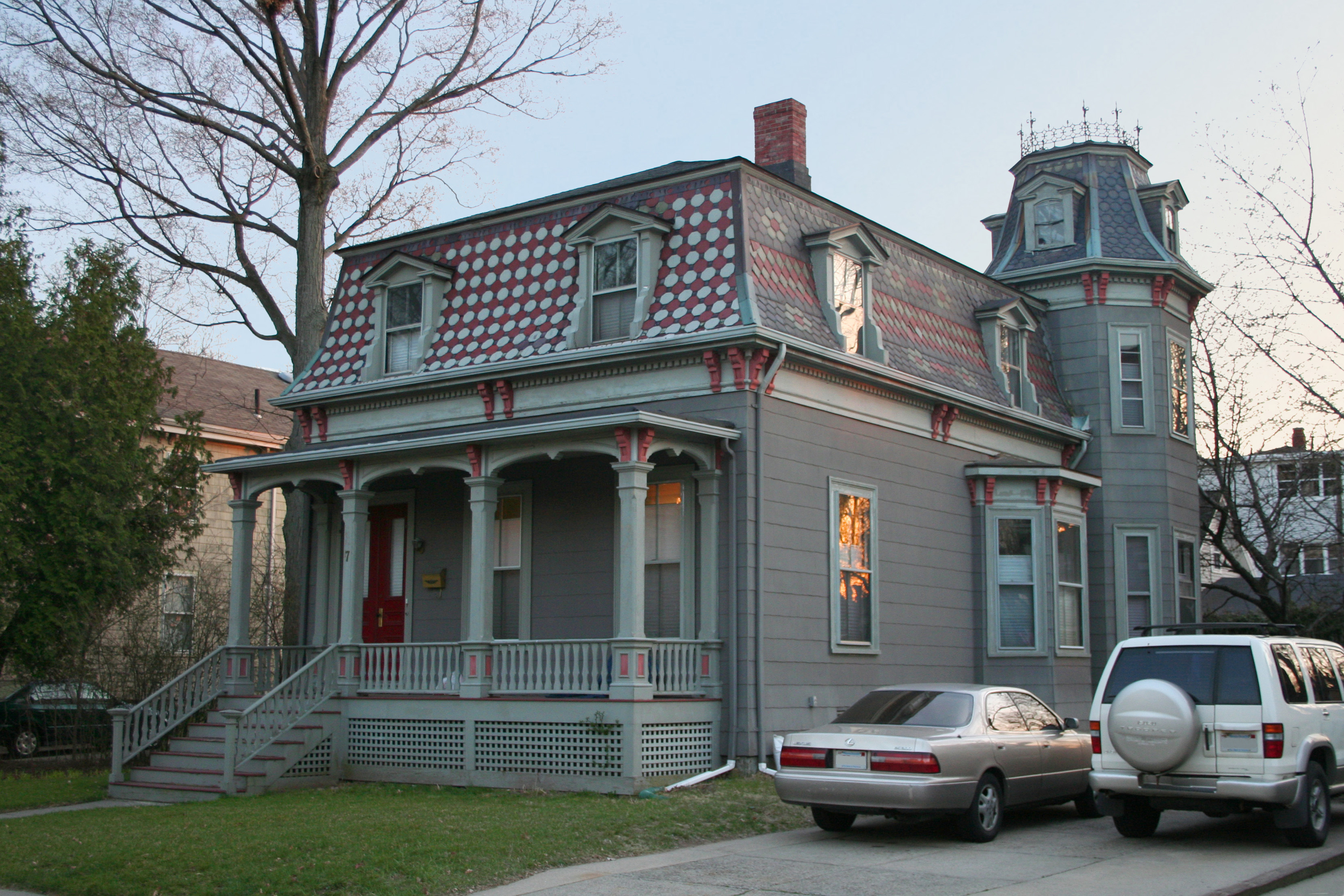
What is a Second Empire house?
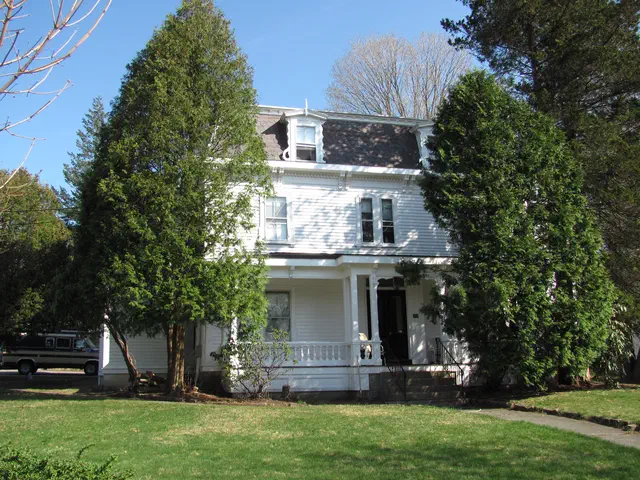
Second Empire is the stately, French-inspired Victorian that most people picture when they imagine a “haunted house.” It came to America from the Paris of Napoleon III and had its run here from about the 1860s through the 1880s. These were the fashionable, high-style homes of their day, built when a family wanted the whole street to know they had arrived.
Almost all of the look is the roof. Instead of an ordinary peaked roof, a Second Empire house wears a mansard: a steep, near-vertical wall of roof that wraps all four sides, studded with dormer windows and holding a full, usable top floor inside.
Why it’s special
The mansard roof is the whole idea, and a smart one. It turns the wasted space of a normal attic into real rooms with headroom and windows, an extra story without the house looking taller from the street. Then there is the decoration: patterned slate in colored bands or fish-scale shapes, tall paired windows with carved hoods, and lacy iron cresting running along the flat top like a crown.
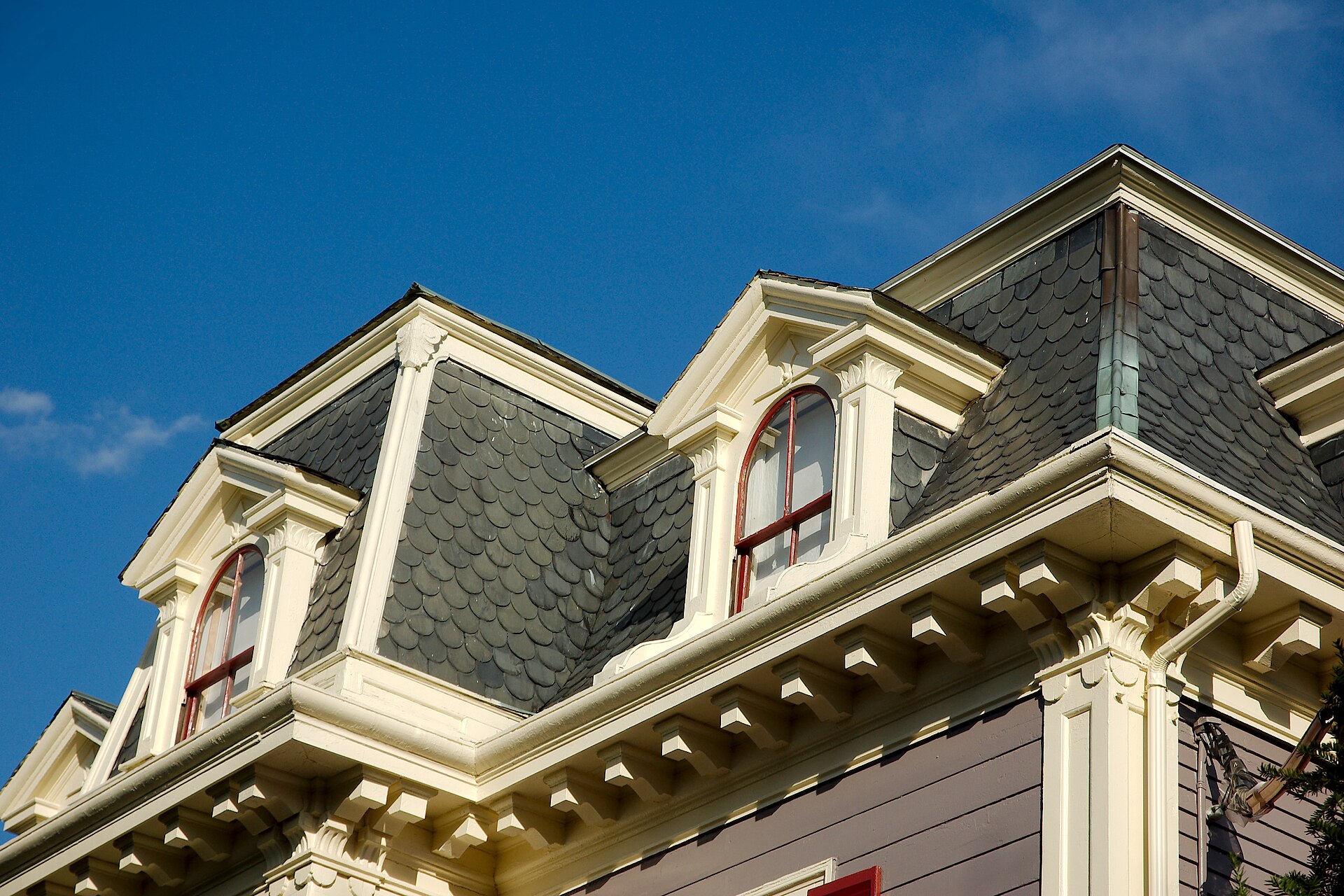
What it’s like to live in one
These homes feel formal and generous, with high ceilings, large rooms, and light pouring through the tall windows. The top floor under the mansard is often the most charming space, with sloped walls and dormers that make cozy bedrooms or a study. In Massachusetts they cluster in two settings: city rowhouse blocks, above all Boston’s South End, where bay-fronted brownstones with mansard tops fill street after street; and the free-standing mansion, built for mill owners in Worcester, Lowell, and Fall River. The mansard’s slopes and dormers take real maintenance, so budget for the roof along with heating and wiring.
Is it the real thing?
Second Empire is one of the easier styles to spot, because the mansard roof gives it away. If a house has that steep, dormer-filled roof wrapping all four sides, you are almost certainly looking at one. Many share details with the Italianate style next door, like bracketed cornices and paired windows, so the same house can honestly be both; the mansard is what tips it into Second Empire. For classification we look for a build date roughly between 1855 and 1890 plus a mansard roof confirmed in photos, a historic-survey record, or an assessor record.
Last reviewed
Common questions about Second Empire homes
How do you identify a Second Empire home?
- Steep, near-vertical mansard roof that wraps all four sides
- Rows of dormer windows set into the roof
- Decorative slate on the roof, sometimes in colored bands or fish-scale patterns
- Tall narrow windows, often paired, with fancy hoods over them
- Decorative iron cresting running along the flat top of the roof
When were Second Empire homes built?
Second Empire homes were built during 1855–1890.
Where in Massachusetts are Second Empire homes found?
- Boston — South End, Bay Village, Roxbury, Dorchester
- Cambridge — selective examples (East Cambridge)
- Industrial mill cities — Worcester, Springfield, Lowell, Fall River, New Bedford
Who designed notable Second Empire homes in Massachusetts?
- Alfred B. Mullett — Old Executive Office Building (Washington DC) was the canonical American example
- Snell & Gregerson — Boston commercial work
- Bryant & Rogers — Boston civic buildings
Current listings (34)
For Sale
Converted Church
$2,500,000
475 E 4th Street
Boston
3 bds | 3.5 ba | 3,023 sqft | Built 1899
MLS ID #73481268, Gibson Sotheby's International Realty
For Sale
$599,999
33 Burbank St
Millbury
4 bds | 1.5 ba | 3,148 sqft | Built 1880
MLS ID #73536977, OWN IT
For Sale
$5,495,000
50 Beacon Street
Boston
3 bds | 3.5 ba | 3,116 sqft | Built 1875
MLS ID #73536923, Gibson Sotheby's International Realty
Under Contract
$1,350,000
138 LOTHROP STREET
Beverly
4 bds | 3.5 ba | 2,769 sqft | Built 1874
MLS ID #73531559, Coldwell Banker Realty - Beverly
For Sale
$2,799,000
795 E 4Th St
Boston
4 bds | 3.5 ba | 2,783 sqft | Built 1910
MLS ID #73530359, Compass
For Sale
$459,900
27 Mattoon Street
Springfield
3 bds | 2.5 ba | 3,204 sqft | Built 1872
MLS ID #73526621, Coldwell Banker Realty - Western MA
For Sale
$1,279,000
295 Concord Road
Sudbury
3 bds | 2.5 ba | 2,569 sqft | Built 1830
MLS ID #73524363, Coldwell Banker Realty - Sudbury
For Sale
$899,900
96 Hollis Street
Groton
5 bds | 4 ba | 3,694 sqft | Built 1840
MLS ID #73523628, Compass
For Sale
$2,399,000
91 N STREET
Boston
3 bds | 2 ba | 3,020 sqft | Built 1872
MLS ID #73519616, Perry DiNatale Realty
For Sale
$1,499,000
14 Beckler Avenue
Boston
3 bds | 2.5 ba | 2,171 sqft | Built 1885
MLS ID #73491288, Coldwell Banker Realty - Boston
For Sale
$8,995,000
158 W Canton St
Boston
5 bds | 5.5 ba | 4,133 sqft | Built 1890
MLS ID #73485860, Coldwell Banker Realty - Boston
For Sale
$6,250,000
374 Nahant
Nahant
10 bds | 7.5 ba | 9,234 sqft | Built 1865
MLS ID #73535142, Coldwell Banker Realty - Marblehead
For Sale
$2,495,000
90 Puritan Road
Swampscott
5 bds | 5 ba | 4,175 sqft | Built 1874
MLS ID #73513051, The Proper Nest Real Estate
For Sale
$2,395,000
407A Broadway
Cambridge
3 bds | 4 ba | 3,575 sqft | Built 1886
MLS ID #73533701, Compass
Under Contract
$449,000
28 Medford St
Chelsea
4 bds | 2 ba | 1,939 sqft | Built 1857
MLS ID #73529733, Lyv Realty
For Sale
$8,250,000
189 W Brookline St
Boston
6 bds | 5 ba | 4,320 sqft | Built 2021
MLS ID #73525666, Coldwell Banker Realty - Boston
For Sale
$3,199,000
4 Center Street
Provincetown
4 bds | 2.5 ba | 3,312 sqft | Built 1870
MLS ID #73528614, Gibson Sotheby's International Realty
For Sale
$799,000
28 Fifield St
Boston
5 bds | 2.5 ba | 1,764 sqft | Built 1899
MLS ID #73515117, Keller Williams Realty Boston-Metro
For Sale
$3,600,000
32 Chesley Road
Newton
6 bds | 6.5 ba | 6,585 sqft | Built 1860
MLS ID #73514286, Centre Realty Group
For Sale
$1,199,000
89 Pond St
Natick
5 bds | 2.5 ba | 2,669 sqft | Built 1870
MLS ID #73511333, Compass
For Sale
$319,000
67 Church St
Ware
4 bds | 1.5 ba | 2,193 sqft | Built 1880
MLS ID #73506435, Milestone Real Estate LLC
For Sale
$875,000
63 Beech Glen St
Boston
6 bds | 1 ba | 2,280 sqft | Built 1850
MLS ID #73503059, Helix Real Estate
For Sale
$7,500,000
8 Otis Place
Boston
4 bds | 5 ba | 4,896 sqft | Built 1890
MLS ID #73500441, Campion & Company Fine Homes Real Estate
For Sale
$1,700,000
11 Taylor Street
Littleton
6 bds | 6 ba | 4,275 sqft | Built 1900
MLS ID #73484940, Lamacchia Realty, Inc.
For Sale
$1,490,000
31 WORTHINGTON ST.
Boston
5 bds | 2.5 ba | 2,016 sqft | Built 1872
MLS ID #73494901, Circle Properties
For Sale
$3,995,000
48 Appleton
Boston
4 bds | 3.5 ba | 3,600 sqft | Built 1890
MLS ID #73482506, Compass
For Sale
$4,585,000
70 Montgomery St
Boston
4 bds | 3.5 ba | 3,288 sqft | Built 1860
MLS ID #73495146, Rondeau/Tierney Real Estate, LLC
For Sale
$3,099,000
93 Third St
Cambridge
5 bds | 3.5 ba | 3,184 sqft | Built 1861
MLS ID #73479996, Douglas Elliman Real Estate - The Sarkis Team
For Sale
$799,000
16 N Main St
West Boylston
3 bds | 2.5 ba | 2,801 sqft | Built 1850
MLS ID #73436098, OWN IT
For Sale
$510,000
24 Clinton St
Marlborough
3 bds | 1.5 ba | 1,488 sqft | Built 1890
MLS ID #73433074, Mega Realty Services
For Sale
$2,850,000
5 Dartmouth Pl
Boston
4 bds | 4 ba | 1,992 sqft | Built 1900
MLS ID #73472078, South End Realty Group
For Sale
$12,900,000
55-57 Hancock St
Boston
5 bds | 6.5 ba | 7,777 sqft | Built 1876
MLS ID #73473428, Olde Forge Realty
Sold
$2,150,000
14 North Street
Manchester
5 bds | 2.5 ba | 3,592 sqft | Built 1906
MLS ID #73509618, Compass
Sold
$2,900,000
11 Chester St.
Newton
5 bds | 4 ba | 3,499 sqft | Built 1873
MLS ID #73502024, Hammond Residential Real Estate