Unique Homes MA
Mid-Century Modern Homes in Massachusetts
MA's mid-century modernist enclaves — Six Moon Hill, Five Fields, Peacock Farm, Conantum — are among the most important post-war architectural communities in America. Plus scattered Compass Homes, Tech-Built, and Garrison-influenced contemporaries.
What is a mid-century modern home?
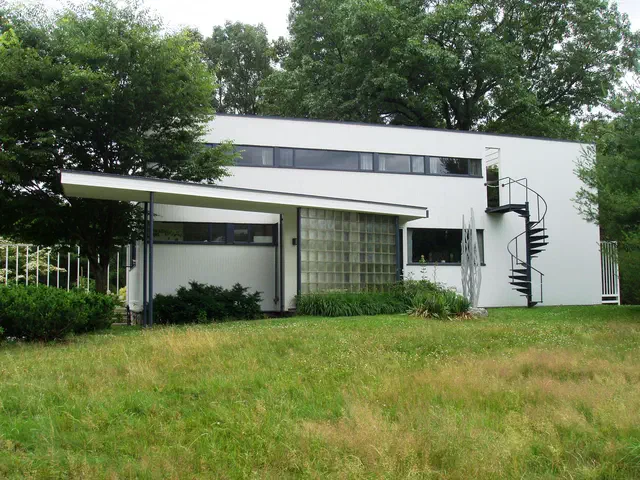
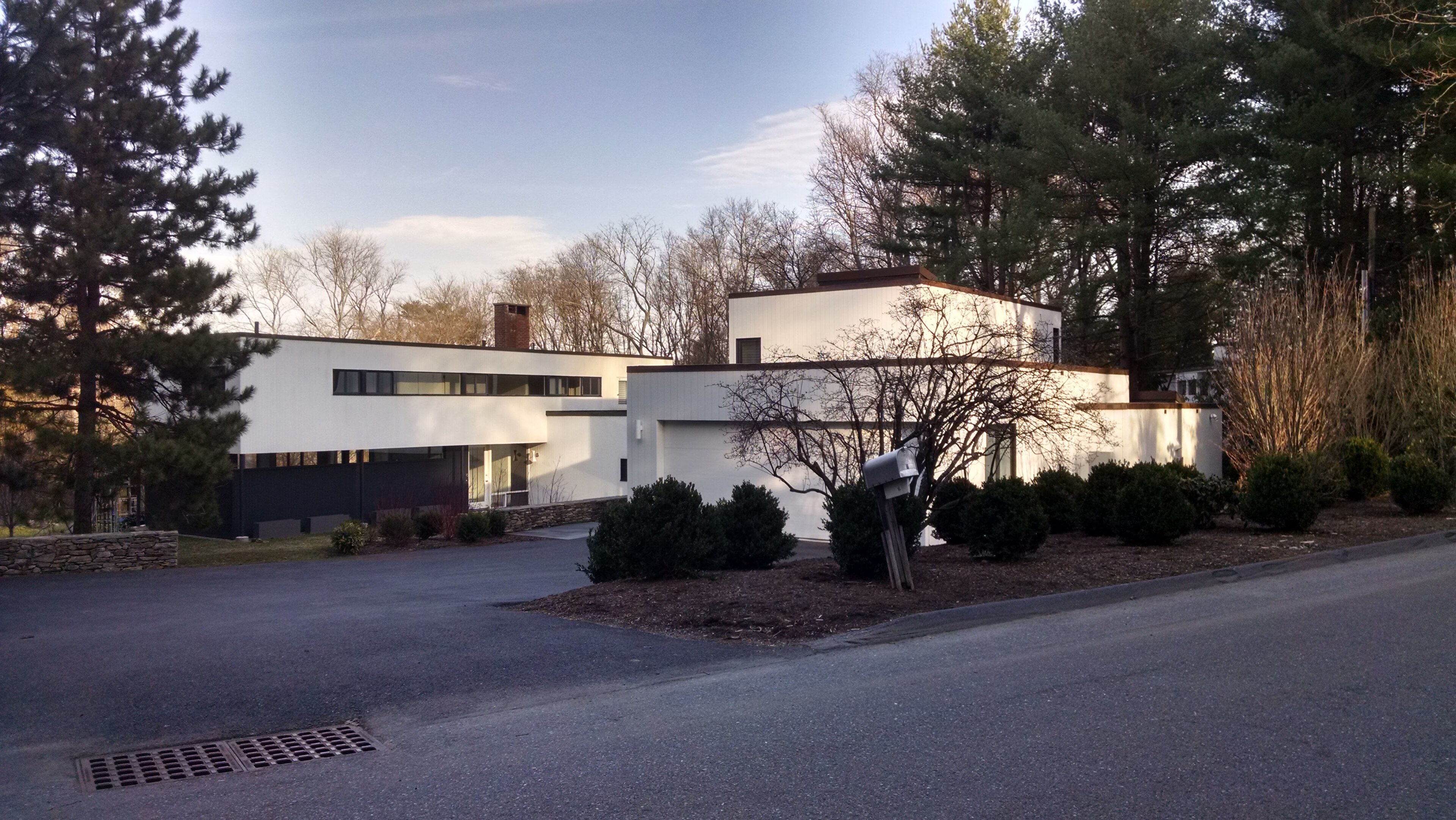
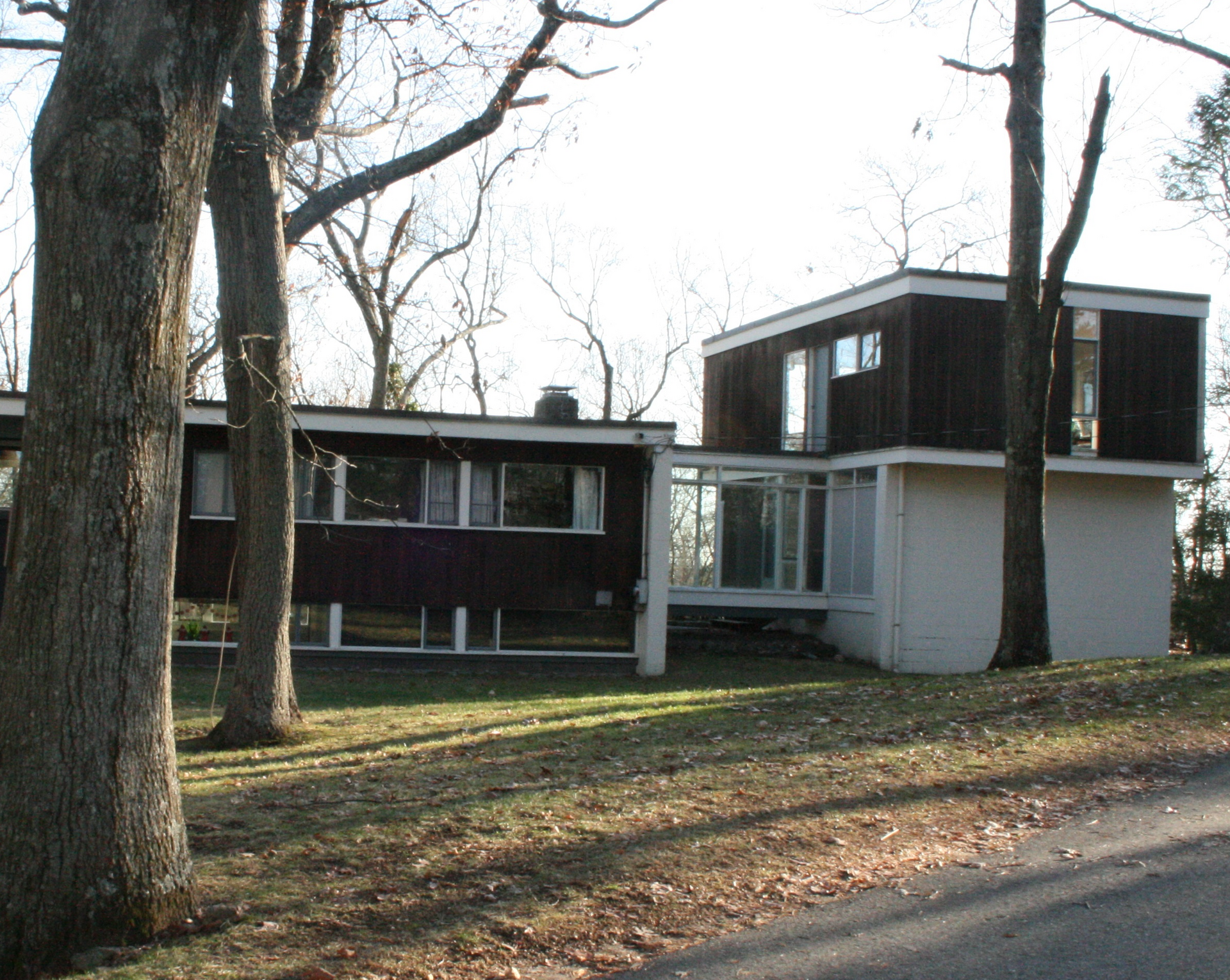
A mid-century modern is the post-war house that looks like the future people imagined in the 1950s. Most were built between 1945 and 1970, when young families left the city for the wooded suburbs west of Boston. These sit low and long against the land, with clean horizontal lines, big walls of glass, and rooms that flow into each other. Massachusetts is where the style took root. Walter Gropius came to teach at Harvard in 1937 and built his own glass-and-wood house in Lincoln; his students founded The Architects Collaborative in 1945 and were soon building whole neighborhoods. Carl Koch did the same in Concord with a prefab system called Tech-Built.
Why it’s special
The big idea was to live with the outdoors, not shut it out. Walls of windows bring the trees and light inside, and builders left the old oaks standing and tucked the houses among them, so these streets still feel like a forest with homes in it. Inside, the kitchen, dining, and living areas became one shared great room, an idea these architects helped invent. Built-in shelves, closets, and dividers came as part of the house.
What it’s like to live in one
Living in one feels calm and connected to nature, with a wooded setting rare this close to Boston. They cluster in a few famous neighborhoods, most in Lexington: Six Moon Hill (the founding one, from 1949), Five Fields, Peacock Farm, and the large Turning Mill. Conantum sits in Concord, while Lincoln and Belmont have Brown’s Wood and Snake Hill. Know what you are buying: the single-pane glass that makes these houses glow also leaks heat, flat roofs need watching, and a few enclaves have rules about changes.
Is it the real thing?
The best of these are collector houses, and a documented original sells at a premium over a generic ranch from the same decade. The clearest proof is the architect: homes by The Architects Collaborative or Carl Koch, or by builder Walter Pierce, are the genuine article. Original built-ins, original windows, and the untouched relationship between house and trees all point the same way. For an enclave tag on this site, we draw each neighborhood’s boundary by hand, and a house has to sit inside it with a build date within about ten years of the enclave. That keeps a stray 1960s colonial from being swept in.
Last reviewed
Common questions about Mid Century Modern homes
How do you identify a Mid Century Modern home?
- Low, horizontal shape, usually one or one-and-a-half stories
- Flat or shallow gable roofs with deep overhangs
- Open floor plan around one big shared living space
- Large windows, sometimes floor to ceiling
- A carport instead of an enclosed garage
When were Mid Century Modern homes built?
Mid Century Modern homes were built during 1945–1975.
Where in Massachusetts are Mid Century Modern homes found?
- Lexington (highest concentration — 4 named enclaves)
- Lincoln (Gropius House plus Brown's Wood, scattered Hoover work)
- Concord (Conantum)
Who designed notable Mid Century Modern homes in Massachusetts?
- The Architects Collaborative (TAC) — Walter Gropius and partners
- Walter Pierce / Compass Homes — Peacock Farm, Turning Mill
- Carl Koch — Tech-Built, Conantum
- Henry Hoover — Lincoln modernist work
- Benjamin Thompson — TAC and later Design Research
Current listings (36)
For Sale
$449,000
209 N. Valley Rd
Pelham
3 bds | 2.5 ba | 2,264 sqft | Built 1971
MLS ID #73521846, www.HomeZu.com
For Sale
$519,000
42 Ellis Dr.
Worcester
3 bds | 1 ba | 1,643 sqft | Built 1955
MLS ID #73486069, RE/MAX Vision
For Sale
$4,998,500
9 Singletree Rd
Brookline
3 bds | 4.5 ba | 6,790 sqft | Built 1970
MLS ID #73520842, Coldwell Banker Realty - Brookline
For Sale
$1,149,000
146 Burroughs Rd
Braintree
4 bds | 3 ba | 3,564 sqft | Built 1967
MLS ID #73535342, Cusack & Associates
Under Contract
$1,180,000
131 Nowell Farme Road
Carlisle
4 bds | 2 ba | 2,595 sqft | Built 1975
MLS ID #73529973, Barrett Sotheby's International Realty
For Sale
$2,490,000
24 Barberry Rd
Lexington
5 bds | 4.5 ba | 4,090 sqft | Built 1960
MLS ID #73499131, Compass
Under Contract
$1,150,000
39 Long Ridge Road
Carlisle
4 bds | 2 ba | 2,564 sqft | Built 1974
MLS ID #73529037, Coldwell Banker Realty - Concord
For Sale
$1,700,000
6 Angier Rd
Lexington
5 bds | 2.5 ba | 3,080 sqft | Built 1962
MLS ID #73529859, MA Properties
Under Contract
$629,000
50 Little Rest Rd
Brimfield
3 bds | 2 ba | 2,743 sqft | Built 1958
MLS ID #73528072, RE/MAX Prof Associates
Under Contract
$749,900
50 Notre Dame Rd
Bedford
3 bds | 1.5 ba | 1,923 sqft | Built 1972
MLS ID #73526289, Leading Edge Real Estate
For Sale
$2,250,000
50 SW Main St
Douglas
5 bds | 6 ba | 6,422 sqft | Built 1975
MLS ID #73528748, Keller Williams Boston MetroWest
Under Contract
$1,950,000
7 Diamond Rd
Lexington
4 bds | 3.5 ba | 3,474 sqft | Built 1963
MLS ID #73525348, Compass
Under Contract
$1,399,000
11 Hiddenwood Path
Lincoln
4 bds | 3 ba | 2,890 sqft | Built 1965
MLS ID #73524068, Compass
For Sale
$1,250,000
50 Carlisle Pines Drive
Carlisle
3 bds | 2 ba | 2,297 sqft | Built 1973
MLS ID #73524788, Coldwell Banker Realty - Concord
Under Contract
$570,000
8 Teawaddle Hill Rd
Leverett
4 bds | 3 ba | 2,272 sqft | Built 1956
MLS ID #73523386, Coldwell Banker Community REALTORS®
For Sale
$875,000
27 Clearview Drive
Framingham
3 bds | 2.5 ba | 2,097 sqft | Built 1959
MLS ID #73519557, Lamacchia Realty, Inc.
For Sale
$969,900
12 Stevens Place
Saugus
4 bds | 2 ba | 2,355 sqft | Built 1968
MLS ID #73510793, Advantage Realty & Rentals
Under Contract
$1,499,000
42 Peacock Farm Rd
Lexington
4 bds | 3 ba | 2,148 sqft | Built 1958
MLS ID #73509162, Compass
For Sale
$1,749,000
5 Gould Rd
Lexington
4 bds | 2.5 ba | 1,757 sqft | Built 1958
MLS ID #73506012, Be Live in Realty
Under Contract
$1,275,000
52 Turning Mill Road
Lexington
4 bds | 3 ba | 2,300 sqft | Built 1961
MLS ID #73506150, Coldwell Banker Realty - Lexington
Under Contract
$3,049,000
995 Brush Hill Rd
Milton
4 bds | 3.5 ba | 6,790 sqft | Built 1967
MLS ID #73504839, Ceres Real Estate
For Sale
$2,399,000
367 Newton St
Brookline
4 bds | 3 ba | 3,243 sqft | Built 1962
MLS ID #73494272, Compass
For Sale
$5,199,000
9 Singletree Road
Brookline
3 bds | 4.5 ba | 6,790 sqft | Built 1970
MLS ID #73487323, Sky Realty, LLC
For Sale
$1,279,000
620 Edmands Rd
Framingham
4 bds | 3 ba | 4,256 sqft | Built 1971
MLS ID #73463759, Raymond Douglas Living
Sold
$832,000
6 Briggs Pond Way
Sharon
4 bds | 2.5 ba | 2,428 sqft | Built 1968
MLS ID #73510764, Real Broker MA, LLC
Sold
$796,000
6 Folly LN
Westborough
4 bds | 2 ba | 2,362 sqft | Built 1952
MLS ID #73489024, Lamacchia Realty, Inc.
Sold
$842,000
243 Concord Road
Westford
3 bds | 2 ba | 2,396 sqft | Built 1955
MLS ID #73499037, Keller Williams Realty Boston Northwest
Sold
$1,165,000
6 Osprey Road
Sharon
3 bds | 3 ba | 3,004 sqft | Built 1975
MLS ID #73503076, Real Broker MA, LLC
Sold
$1,925,000
6 Wachusett DR
Lexington
4 bds | 3 ba | 1,950 sqft | Built 1964
MLS ID #73500897, Steve Bremis Realty Group
Sold
$1,525,000
7 Gould Road
Lexington
4 bds | 2.5 ba | 1,680 sqft | Built 1957
MLS ID #73506369, Churchill Properties
Sold
Designed by The Architects Collaborative
$1,385,000
542 Concord Avenue
Lexington
5 bds | 3 ba | 2,466 sqft | Built 1952
MLS ID #73491499, Gibson Sotheby's International Realty
Sold
$1,645,000
27 Peacock Farm Rd
Lexington
4 bds | 3.5 ba | 2,510 sqft | Built 1956
MLS ID #73494394, Compass
Sold
$2,170,000
33 Turning Mill Road
Lexington
5 bds | 3.5 ba | 3,424 sqft | Built 1966
MLS ID #73491517, Keller Williams Realty Boston Northwest
Sold
$1,970,000
32 Moon Hill Road
Lexington
4 bds | 3 ba | 2,220 sqft | Built 1950
MLS ID #73485544, Coldwell Banker Realty - Cambridge
Sold
$1,850,000
23 Dewey Rd
Lexington
5 bds | 2.5 ba | 2,786 sqft | Built 1970
MLS ID #73482476, Compass
Sold
$1,950,000
7 Field Rd
Lexington
4 bds | 3.5 ba | 4,005 sqft | Built 1952
MLS ID #73478792, Compass