Unique Homes MA
Garrison Colonial Homes in Massachusetts
The Garrison Colonial (1935-1975) is a Colonial Revival sub-style with a second story that overhangs the first — a borrowed motif from 17th-century English-overhang houses, mass-produced for postwar subdivisions.
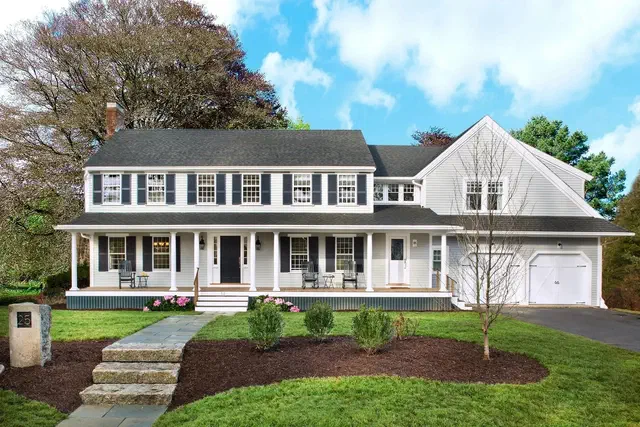
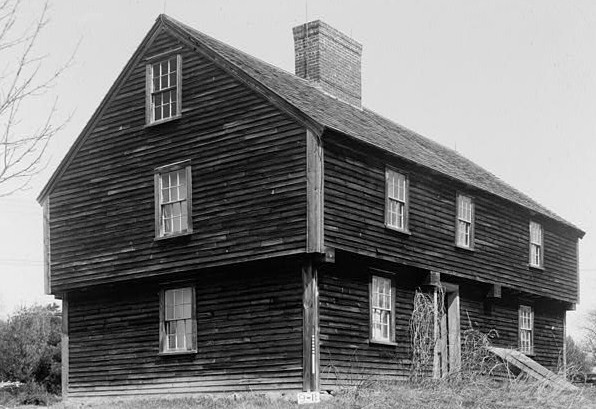
What is a Garrison Colonial?
A Garrison Colonial is a tidy two-story house with one memorable trick: the upstairs juts out a little over the downstairs across the front. That forward step, called a jetty, is the whole signature, sometimes with short carved wood drops at the corners. Underneath the detail it is a familiar Colonial Revival house, with a center door, two windows on each side, a steep gable roof, white clapboards, and dark shutters. The look borrows from old houses with overhanging upper floors, though the name is pure 20th-century marketing. Most were built by the thousand between about 1950 and 1970 for young families moving to the suburbs.
Why it’s special
The overhang gives an ordinary builder’s colonial real character. It costs almost nothing to add, yet it makes the front feel deliberate and a touch old-fashioned, which was the appeal. The nicer ones lean into it: custom Garrisons from the Royal Barry Wills era carry turned wood drops at the corners and a dressed-up front entry.
What it’s like to live in one
A Garrison lives like a roomy, practical family house: three or four bedrooms upstairs, the public rooms below, usually a garage off one side. They were built for kids, school buses, and backyards, and still do that job well. You will find them all over Boston’s postwar suburbs. Framingham, Natick, Sudbury, Wayland, Westwood, and Norwood have whole streets of them, and Lexington, Burlington, and Bedford carry heavy stock from the late 1950s and 60s. The Campanelli Brothers built them around Brockton, Stoughton, and Norton. Most have been modernized once, so check the roof, windows, and mechanicals.

Is it the real thing?
Look at the upper wall. If the second story steps forward over the first, it is a Garrison. If the upstairs sits flush, it is a plain center-entrance colonial. If the back roof slopes down to a single story in the rear, that is a Saltbox, a much older type. A few listings claim a Royal Barry Wills design; Wills (1895-1962) and his firm designed Garrisons into the 1970s, recognizable by careful proportions and a fancier entry. The builder page separates documented work from houses merely attributed to him.
Last reviewed
Common questions about Garrison homes
How do you identify a Garrison home?
- Two stories, with the upper floor projecting forward over the front wall
- A small ledge or molding line where the second story juts out above the first-floor windows
- Symmetrical front: a center door with two windows on each side
- Steep side-gabled roof
- Decorative wood drops hanging at the corners of the overhang on fancier examples
When were Garrison homes built?
Garrison homes were built during 1935–1975.
Where in Massachusetts are Garrison homes found?
- Postwar tract suburbs — Framingham, Natick, Sudbury, Wayland, Westwood, Norwood
- Inner-ring suburbs that expanded postwar — Lexington, Burlington, Bedford, Reading
- Campanelli-developed neighborhoods — Brockton, Stoughton, Norton, Bridgewater
Who designed notable Garrison homes in Massachusetts?
- Royal Barry Wills (mid-century Garrison Colonial design work, especially 1940s-50s)
- Hugh Stubbins (occasional Garrison-Modernist hybrids)
- Campanelli Brothers (Brockton-area Garrison tract developments)
- Most are stock plans from regional builders — Levitt, Capeway Homes, Boise Cascade kits