 Unique Homes MA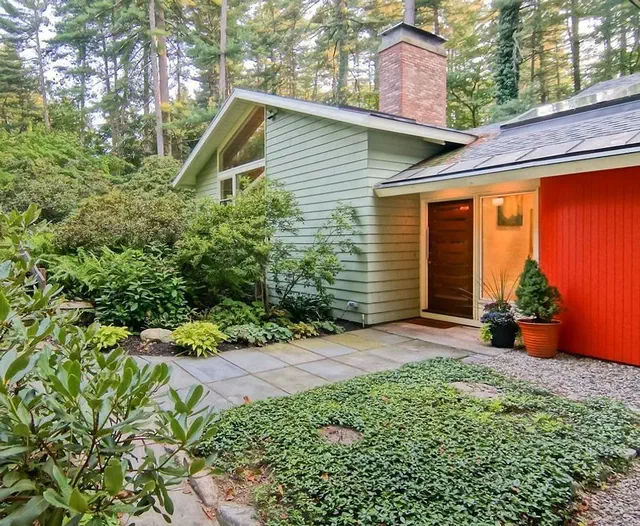
Conantum
~100 prefabricated modernist homes on Hawthorne Lane, Heath's Bridge Road, Garland Road, and Garfield Road, off Sudbury Road.
About 100 prefabricated modernist homes line Hawthorne Lane, Heath’s Bridge Road, Garland Road, and Garfield Road, off Sudbury Road in Concord. The Techbuilt prototype used factory-built post-and-beam frames and modular panels designed for the post-war first-time buyer. Conantum was established in 1952 as a planned development of 103 homes on 190 wooded acres.
Architect Carl Koch adopted the name “Conantum” from Henry David Thoreau’s coinage for the Kalmia Woods area where the neighborhood was developed. Koch later contributed to other prefabrication projects, including Lustron homes and his successful Techbuilt company. He also designed houses at Snake Hill in Belmont and informed the broader Lincoln modernist scene at Brown’s Wood. Today, with association dues of around $200 per year, Conantum is an extraordinary bargain for the community amenities you get with it.
Conantum’s site plan was unusual for early-1950s suburban Massachusetts: lots range from one to three acres, the street network follows the contours rather than overriding them, and roughly a third of the original parcel is held in common as woodland and trails. Koch’s panelized framing system kept construction costs low enough that academics and scientists from MIT, Lincoln Lab, and Harvard could buy in. Conantum’s first residents skewed heavily toward that scientific-professional cohort, and the neighborhood’s intellectual culture (lectures, communal gardens, a self-published newsletter) is still part of how residents describe the place. The houses sit firmly in the Mid-Century Modern tradition.
Learn more about the Conantum community and its history at Conantum.org.
Last reviewed