 Unique Homes MA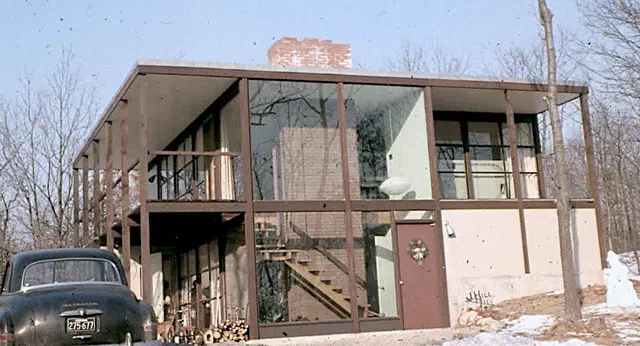
Brown's Wood
Small modernist cluster on Old Concord Road, Wells Road, and surrounding streets in eastern Lincoln.
Described as Lincoln’s utopian neighborhood, Brown’s Wood is a small modernist cluster on Old Concord Road, Wells Road, and surrounding streets in eastern Lincoln. About 27 contemporary homes share the design language of the better-known enclaves nearby.
Brown’s Wood started in 1953 as a cooperative community founded by MIT colleagues Ranny and Ann Gras, among others, built on a woodlot owned by Deacon Benjamin Brown. The neighborhood is an approximately 110-acre residential subdivision. (Three Colonial Revival-style houses built in the Brown’s Wood area before 1964 are not associated with Brown’s Wood, Inc.)
Henry B. Hoover, Lincoln’s most prolific Mid-Century Modern architect, designed many of the original houses in the post-and-beam, low-slung idiom that defined the town’s modernist enclaves. His siting strategy gives the neighborhood its quiet feel: each house tucked into the existing tree canopy on a long driveway, oriented toward a private rear yard rather than the road, with carports rather than garages facing the street. Lots are large by Massachusetts standards (one acre and up is typical) because the cooperative founders wanted to keep mature woods between the houses. Later phases brought in Acorn and Deck House infill, the prefabricated post-and-beam line that became Lincoln’s other signature mid-century vernacular. Brown’s Wood reads in the same architectural family as nearby Conantum in Concord and the older Snake Hill cluster on the Belmont line.
Learn more from the Lincoln Historical Society and the Massachusetts Historical Commission (MHC) report on Brown’s Wood and surrounding communities, plus the Brown’s Woods Neighborhood Association proposals.
Last reviewed