 Unique Homes MA
Acorn / Deck House: Massachusetts Post-and-Beam Modernism
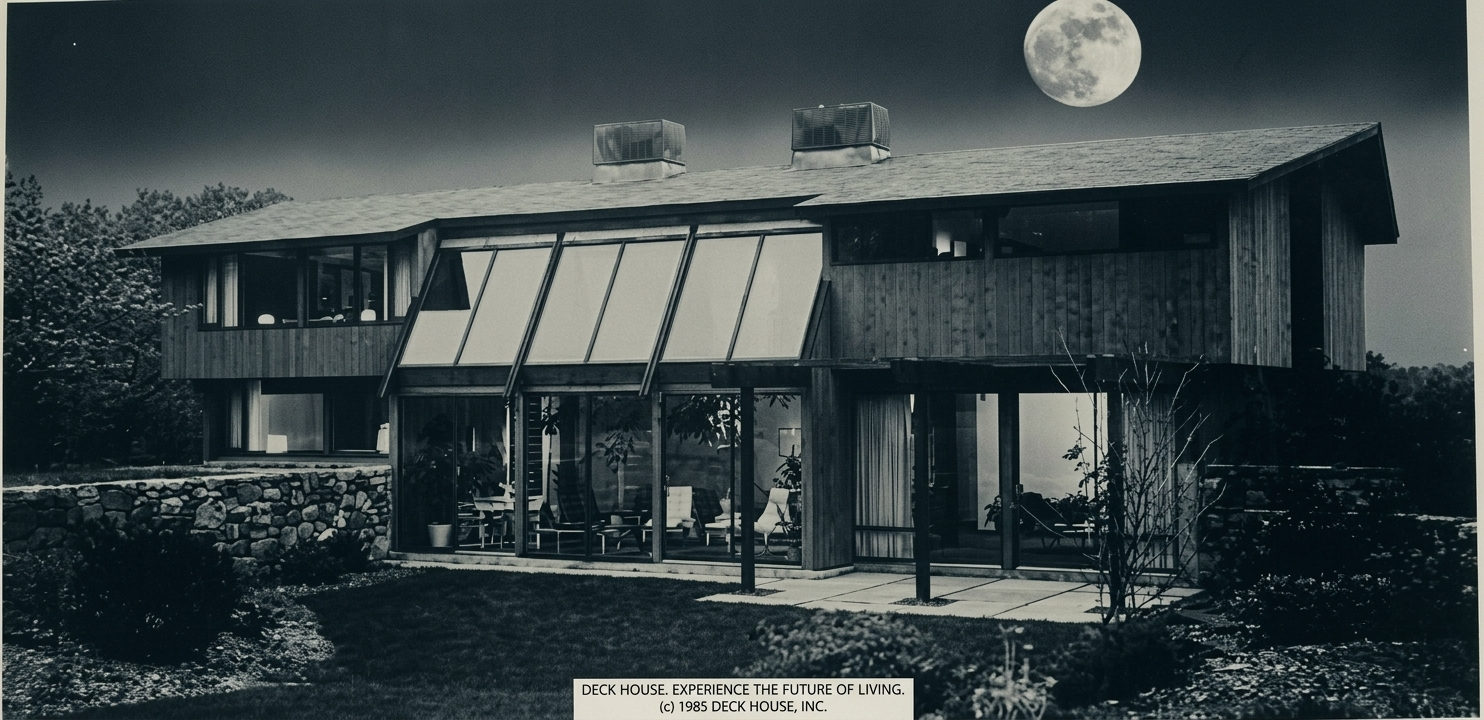
Acorn and Deck House (1947-1990s) were the dominant MA-based prefab modernist housing companies — flat-roofed, post-and-beam, glass-walled contemporary homes shipped from Acton and Concord factories.

What is an Acorn or Deck House?
These are New England’s two big makers of modern kit homes. Carl Koch started Acorn Structures in Acton in 1947 to bring clean modern design, the look he knew from working with Walter Gropius, to ordinary families at a reachable price. Deck House followed in 1959, founded by a former Acorn man, and built much the same home. Both cut every part in a factory, then trucked the package to your lot. Neither sells kits anymore, so the standing houses are all there will be.
Why it’s special
The house is built around a wooden frame of big posts and beams left in the open, with no drywall hiding the ceiling. Because the frame carries the weight, one whole side can be glass. That glass wall is the heart of it, facing the best view and pulling trees, water, or hillside into the living room. Outside, the closed walls wear vertical cedar or redwood weathered to silver grey.
What it’s like to live in one
People notice the light first. The glass wall puts the outdoors in the room, and the wood ceilings keep it warm. The main floor is usually one open space for living, dining, and cooking, with bedrooms in a wing or up in a loft.
In Massachusetts they cluster in a few towns. Lincoln has the most, with whole pockets like Brown’s Wood. Concord, Carlisle, and Lexington hold early Acorns, and Wellesley and Weston got larger later models. They ask for care: the cedar needs staining, the original glass walls are due for replacement, and the beam ends should be checked for water damage.
Is it the real thing?
Many homes sold as “contemporary” borrow the open plan and big windows without being a real Acorn or Deck House. The surest sign is the exposed frame and wood ceilings running throughout. The purchase papers often name the maker, and a tuned market like Lincoln or Conantum knows its houses by name. These kits also differ from one-off modern houses an architect drew for a single owner, like those at Six Moon Hill. To classify a listing, we look for that documentary trail or clear factory detailing.
Last reviewed
Current listings (15)
Under Contract
$1,180,000
131 Nowell Farme Road
Carlisle
4 bds | 2 ba | 2,595 sqft | Built 1975
MLS ID #73529973, Barrett Sotheby's International Realty
For Sale
$3,495,000
17 Gosnold Road
Orleans
6 bds | 5 ba | 3,820 sqft | Built 1975
MLS ID #73535155, Gibson Sotheby's International Realty
For Sale
$975,000
40 Bicentennial Way
Boxborough
3 bds | 2.5 ba | 2,631 sqft | Built 1983
MLS ID #73534117, Keller Williams Realty Boston Northwest
Under Contract
$1,150,000
39 Long Ridge Road
Carlisle
4 bds | 2 ba | 2,564 sqft | Built 1974
MLS ID #73529037, Coldwell Banker Realty - Concord
Under Contract
$1,399,000
11 Hiddenwood Path
Lincoln
4 bds | 3 ba | 2,890 sqft | Built 1965
MLS ID #73524068, Compass
For Sale
$1,250,000
50 Carlisle Pines Drive
Carlisle
3 bds | 2 ba | 2,297 sqft | Built 1973
MLS ID #73524788, Coldwell Banker Realty - Concord
For Sale
$1,575,000
518 Annursnac Hill Rd
Concord
6 bds | 2.5 ba | 3,018 sqft | Built 1967
MLS ID #73525102, Coldwell Banker Realty - Concord
For Sale
$1,150,000
262 South Street
Carlisle
4 bds | 2 ba | 2,447 sqft | Built 1978
MLS ID #73517724, Coldwell Banker Realty - Concord
For Sale
$1,779,000
54 Campbell Road
Wayland
4 bds | 3.5 ba | 3,898 sqft | Built 1972
MLS ID #73517459, MGS Group Real Estate LTD - Wellesley
For Sale
$1,095,000
11 Stoney Brook Ln
Dartmouth
3 bds | 2.5 ba | 1,440 sqft | Built 1979
MLS ID #73511302, Robert H. Gardner, Inc.
Sold
$845,000
38 Woodside Rd
Harvard
3 bds | 2.5 ba | 2,569 sqft | Built 1968
MLS ID #73497509, Harvard Realty
Sold
$1,950,000
31 Aaron Way
Carlisle
4 bds | 3.5 ba | 4,900 sqft | Built 1981
MLS ID #73480035, Coldwell Banker Realty - Concord
Sold
$2,150,000
134 Rangeley Rd
Brookline
4 bds | 2.5 ba | 2,704 sqft | Built 1981
MLS ID #73479930, Commonwealth Standard Realty Advisors
Sold
$1,850,000
23 Dewey Rd
Lexington
5 bds | 2.5 ba | 2,786 sqft | Built 1970
MLS ID #73482476, Compass
Sold
$635,000
52 Allens Trail
Groton
4 bds | 2.5 ba | 2,999 sqft | Built 1950
MLS ID #73474261, Keller Williams Realty-Merrimack